Attend a seminar on engineering motion in miniature robots, Sept. 18
About
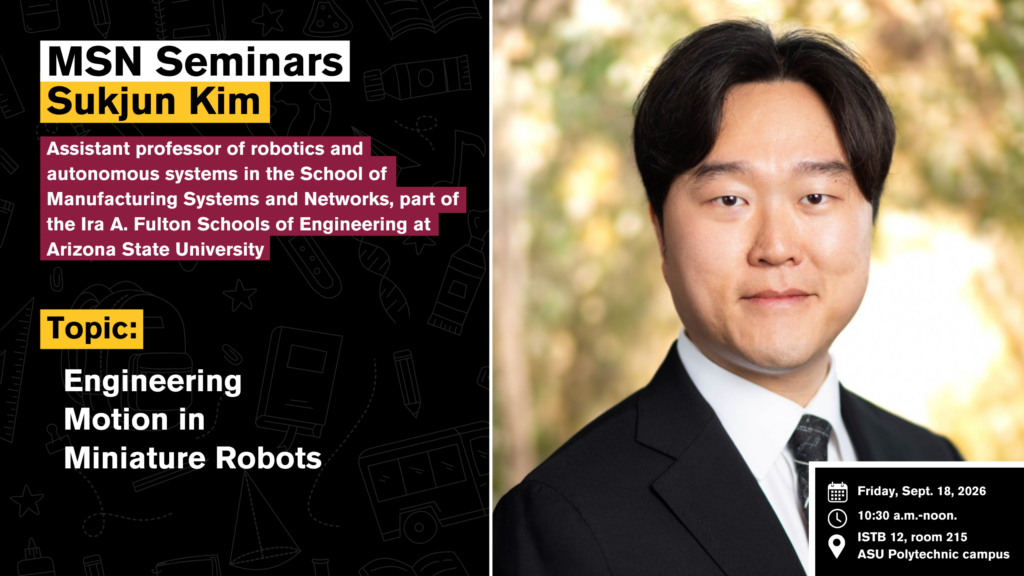
Sukjun Kim is an assistant professor in the School of Manufacturing Systems and Networks, part of the Ira A. Fulton Schools of Engineering at Arizona State University. He served as a postdoctoral researcher in the Department of Mechanical and Aerospace Engineering at the University of California, San Diego, where he developed soft robotic systems for medical applications. He received his bachelor’s degree in mechanical and aerospace engineering from Seoul National University in 2017, and his master’s degree and doctoral degree in mechanical engineering from Carnegie Mellon University in 2021 and 2023, respectively. His doctoral research focused on 3D-printed actuated mechanisms for microrobots, advancing the motion capabilities of microrobotic systems. His research interests include designing miniature soft robotic systems, novel manufacturing and integration methods, and human-centered robotic applications. He is the recipient of the Korean government scholarship program for studying overseas and the Presidential Fellowship from Carnegie Mellon University.
Abstract
Miniature robots that operate at the millimeter and centimeter scale offer unique advantages for several applications, including search and rescue, inspection and health care. For these applications, miniature robots must generate complex and versatile motion for navigation, manipulation and meaningful interaction with their surroundings. However, achieving such motion at small scales remains difficult due to fundamental scaling constraints and the limited availability of scalable fabrication and integration methods.
In this talk, Kim will argue that advances in design, manufacturing and materials are central to expanding the motion capabilities of miniature robots. He will show how new fabrication processes unlock novel mechanical designs and enable the integration of smart materials to advance actuated mechanisms at small scales. Specifically, Kim will present how microscale 3D printing enables electrostatically driven, 3D actuated mechanisms that generate complex motion in microrobotic systems, including the world’s smallest and fastest Delta robot and a 15-milligram hexapod robot. He will then extend his methodology to miniature soft robots and introduce millimeter-scale, steerable soft everting robots driven by liquid crystal elastomers. This robotic system achieves high-curvature bending at multiple points along the body, enabling safe navigation through highly tortuous and constrained environments. This new motion capability shows strong promise for medical and industrial applications.
Engineering Motion in Miniature Robots seminar
Friday, Sept. 18, 2026
10:30 a.m.–noon
Interdisciplinary Science and Technology Building 12 (ITSB 12) room 215, Polytechnic campus [map]